When you feel frozen, it’s rarely because you “lack discipline.” More often, your brain is reacting to one of four things:
Overwhelm (the task feels too big)
Uncertainty (you don’t know what to do first)
Perfection pressure (starting feels like committing to doing it “right”)
Low energy (you’re depleted, so everything feels harder)
This method isn’t about pushing harder. It’s about reducing friction so you can restart motion.
SpreeSpark: If you can’t start, the next step isn’t clear or small enough.
The 2-Minute Unstuck Method
1) Name the block (15 seconds)
Say or write:
“I’m stuck because ______.”
Why it works: naming the barrier turns “stuck” into something specific you can address.
Examples:
“…it feels like too much.”
“…I don’t know what done looks like.”
“…I’m afraid I’ll waste time doing it wrong.”
“…I’m tired.”
2) Define “done” in one sentence (20 seconds)
Write:
“Done means: ______.”
Why it works: vague tasks create endless mental load. Clear “done” gives your brain a finish line.
Examples:
“Done means: an email with 3 bullet points sent.”
“Done means: a rough outline with 5 headings.”
“Done means: dishes in the dishwasher.”
“Done means: the form submitted.”
If it’s a big task, use: “Done for today means: ______.”
3) Pick the smallest next action (25 seconds)
Choose something physical + specific—an action you can do even without confidence.
Good next actions:
Open the doc and type the title
Write the first heading
Create a 3-item checklist
Gather what you need (supplies. resorces)
Send one clarifying message (“Can you confirm X by today?”)
Why it works: your brain resists “a project,” but it can tolerate one step.
4) Set a 2-minute timer and start (60 seconds)
Two minutes is short enough to bypass resistance but long enough to create momentum.
When the timer ends, choose one:
Stop on purpose and schedule the next 10 minutes, or
Continue for another 5–15 minutes if it feels doable
Either way, you’ve changed the state from stalled → started.
If You Still Can’t Start
Use the “one unit” rule:
One sentence
One checkbox
One tab opened
One item put away
One question asked
You’re not trying to finish—you’re trying to break inertia.
Q&A: Getting Unstuck (Common Roadblocks)
Q: What if I don’t know where to start?
Start with Step 2: define “done.” If you can’t, your first 2-minute action is:
“List 3 possible first steps.” Then choose the easiest one.
Q: What if the task feels too big?
Shrink the scope to “done for today.”
Example: not “write the report,” but “create the headings” or “write the first paragraph.” Big tasks move forward through small starts.
Q: What if I’m stuck because I’m tired?
Don’t force a high-output session. Choose a low-energy progress step: outline, prep, organize, or send one message. Momentum still counts when capacity is low.
Q: What if perfectionism is the problem?
Make the first version intentionally rough: label it v0. Your goal is not quality—it’s something editable. You can’t improve what doesn’t exist.
Q: What if I start and still feel stuck after 2 minutes?
That’s normal—stuck can come in layers. Repeat the loop once more:
“I’m stuck because…”
“Done means…”
“Smallest next action…”
Often the second pass reveals the real blocker (uncertainty, unclear finish line, missing info).
Q: What if I’m stuck because I don’t want to do it at all?
That’s not a productivity issue—it’s a priority/values issue. Ask:
Does this actually need to be done?
Can I delegate it?
What’s the minimum acceptable version?
What’s the consequence if I delay it?
Sometimes “unstuck” means reducing the burden, not powering through.
✅ Want help finding easy first steps? Happyspree App → Try ThinkyFit Reframe. Write “I’m stuck because…” → Choose one 2-minute action → 📲 HappySpree https://bit.ly/happyspree
You already know the vibe: New Year’s hits. You feel inspired. You declare a bold resolution like:
“I will lose weight.”
“I will find my dream job.”
“I will finally be consistent.”
And then… life shows up. Stress. Cravings. Procrastination. That “I’ll start Monday” loop. Here’s the truth: resolutions don’t fail because you’re weak. They fail because your conscious mind wants change… but your subconscious mind wants safety.
So when you say, “I will lose weight,” your conscious mind nods—but your subconscious whispers, “This cookie makes me feel better right now.” That internal tug-of-war is exhausting. And brute-force repeating affirmations can actually make the battle louder.
Try a different approach: sync the conscious + subconscious so your goals stop feeling like a fight—and start feeling like momentum.
🔥 SpreeSparks Callout
If your resolution requires constant willpower, it’s built on friction. If your resolution feels emotionally aligned, it’s built on flow.
Why Affirmations Sometimes Don’t Work (And Why You Shouldn’t Quit Them)
Affirmations can be powerful when they’re believable—because positive self-talk can shift attention, build optimism, and strengthen new mental “paths” over time.
The problem isn’t affirmations. The problem is affirmations that your deeper mind rejects. So instead of forcing yourself to repeat something you don’t believe…use these 5 SpreeSpark Secrets to make your resolution feel true enough to grow.
5 Secrets to Make Resolutions Stick
1) Choose Words Your Mind Can Believe (Start Smaller Than You Think)
A resolution like: “I accept myself and I deserve great things” can backfire if your brain instantly pulls up “evidence” against it:
“I’ve messed up before.”
“I’m inconsistent.”
“I always fall off track.”
Instead of forcing belief, build belief. Try a “bridge” statement your mind can’t argue with:
✅ “I’m learning to accept myself more each day.”
✅ “I’m practicing showing up for myself.”
✅ “I deserve good things, and I’m taking one step today.”
Why it works: your brain starts scanning for proof that you’re improving—because it actually feels possible.
2) Turn Your Affirmation Into a Question (Let Curiosity Do the Heavy Lifting)
Your mind loves solving problems. So instead of stating a goal like a command, try asking it like a mystery.
Examples:
“How can I make movement feel easier this week?”
“What would make healthy food feel satisfying today?”
“How can I become the kind of person who follows through?”
Questions invite solutions instead of resistance. If a negative thought pops up (it might), don’t panic—follow it with better questions:
“Why do I feel this way?”
“What do I need right now?”
“What’s one gentle next step?”
“What would I tell a friend in my situation?”
That’s not “positive vibes only.” That’s real alignment.
3) Write the Resolution (Because Thoughts Fade, But Ink Trains Your Brain)
Writing makes your goal concrete. It slows your mind down enough to notice hidden resistance.
Try this SpreeSpark journaling mini-script:
1) My resolution is: __________
2) The part of me that resists is afraid of: __________
3) A version I can believe today is: __________
4) My smallest next step is: __________
Then rewrite your “believable version” 3 times.
Not as punishment. As programming.
✍️ Tiny Ritual, Big Results
Write your resolution where you’ll see it daily: notes app, lock screen, mirror, or journal. Visibility beats motivation.
4) Say It Out Loud (But Make It Short + Real)
Out loud matters because it makes your goal feel solid—less like an idea, more like identity. Keep it simple. Repeat 3 times, 3 times a day (morning / midday / evening).
Try these SpreeSparks-ready examples:
“I keep promises to myself—starting small.”
“I’m building momentum with one step.”
“What’s my next kind choice?”
If it feels fake, reduce the intensity until it feels true. Believable > dramatic. Always.
5) Take One Visible Action Today (Action Is the “Proof” Your Subconscious Needs)
Your subconscious doesn’t trust words. It trusts evidence. So your resolution must include one action that proves, “We’re really doing this.”
If your resolution is:
“How can I live life to the fullest?”
Your action could be:
Text one friend to plan a coffee
Apply to one job
Walk for 8 minutes
Drink a glass of water
Do a 2-minute tidy
Book one therapy session
Learn one small skill
Don’t wait for inspiration. Inspiration is the reward for action.
🚀 The Top Dog Rule
If your resolution has no “today step,” it’s a wish. Add a tiny action and it becomes a system.
SpreeSparks “Copy-Paste” Resolutions That Actually Work
Use these as-is:
For Health
“How can I make my body feel 1% better today?”
“I’m becoming someone who moves daily—even gently.”
For Confidence
“What would self-respect look like in the next 10 minutes?”
“I’m learning to trust myself again.”
For Money / Career
“What’s one move my future self would thank me for?”
“I take small brave actions daily.”
For Relationships
“How can I show love in a way that’s easy to repeat?”
“I build connection one message at a time.”
Q&A: SpreeSpark Resolution Questions People Actually Ask
Q1: Why do I feel motivated for a week and then crash?
Because motivation spikes from novelty. What lasts is identity + environment + tiny routines. Make the goal smaller and repeatable, not heroic.
Q2: What if I don’t believe anything positive about myself?
Start with neutral truth.
Try: “I’m willing to try.”
Or: “I can take one step.”
Belief is built—like muscle.
Q3: Are affirmations better in the morning or at night?
Both can help. Morning sets direction. Night reinforces identity. The real key is consistency—and using words you can believe.
Q4: What’s the fastest way to make a resolution stick?
Pair the resolution with a daily micro-action and track it. Your subconscious changes when it sees proof.
Q5: What should I do when I mess up?
Do the smallest “re-start” possible within 5 minutes.
How the OPTs of Learned Optimism Can Help You Feel Better Fast
We are shaped by what we think. And when life hits hard—like a breakup, a mean work co-worker, or a rough day—our minds can start going dark like a disaster movie:
“My life is awful.”
“This will never end.”
“I’ll die alone and my cat will eat me.”
If your brain has ever gone full dramatic, you’re not broken—you’re human.
The good news? You can train your thoughts to be kinder, more realistic, and more hopeful.
Psychologist Dr. Martin Seligman, a leader in positive psychology, described a powerful tool called the Learned Optimism. This SpreeSpark shows you how to use this quick mood reset to stop spirals and help you feel better fast.
Why Learned Optimism Helps When Life Feels Heavy
Your thinking style affects:
• your mood
• your stress response
• your ability to bounce back
Research shows that pessimistic thinking patterns can increase feelings of discouragement and emotional stuckness. Optimism doesn’t mean pretending everything is fine. It means choosing explanations that help you cope, heal, and move forward.
Bad things happen to everyone.
But how we explain them to ourselves changes how we feel.
The OPTs of Learned Optimism (The Spiral Stopper)
When we’re hurting, our minds often turn problems into:
• “This is all my fault.”
•“This ruins everything.”
• “This will never end.”
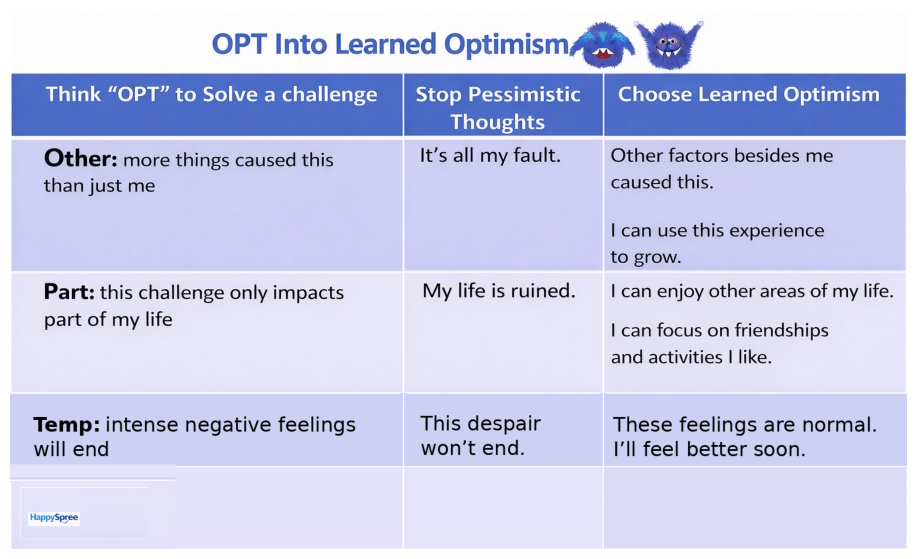
To OPT reframes challanges as:
• Other things caused this besides just me (not all on you)
• Part (this impacts part of my life, not everything)
• Temp (these intense feelings will end)
Let’s break this down for a painful breakup.
1) Other
“What else contributed besides me?”
After a setback, the mind loves to point the finger—usually at you.
But most situations are shaped by many factors: timing, stress, communication, unmet needs, life changes, compatibility. You can learn from your part without carrying the entire weight.
SpreeSpark Reframe for “Other”
Old thought: “It’s all my fault.”
1) Other reframe: “Other things besides me caused this. I can own my part and release the rest.”
Tiny-Win Prompt
Write 3 non-you things that played a role:
• stress at work
• family drama
• different goals or values
• timing or distance
• burnout or mental health
• communication patterns on both sides
Why reframing helps: less shame, less self-criticism, more clarity.
SpreeSpark Reframe for “Part”
Old thought: “Everything is awful.”
2) Part reframe: “This part hurts. Other parts can still be okay.”
Tiny Wins that can help you feel better.
• choose a flow activity (music, writing, cooking, art, walking)
• help someone (purpose boosts mood)
• invest in a friendship or family connection
• spend time with a pet (unconditional love counts)
Why it helps: your brain remembers you’re more than this one chapter.
SpreeSpark Reframe for “Temp”
Old thought: This will hurt forever.”
Believing that pain is permanent can keep your nervous system stuck on high alert. Intense feelings—even grief—are temporary and healing can move forward over time.
3) Temp reframe: “This is painful now, but it will change.”
Tiny-Win Phrases (try one today)
• “This is hard, and it’s normal.”
• “I will feel better with time.”
• “Today is heavy, not permanent.”
• “I’m healing even when I can’t feel it yet.”
Why it helps: your nervous system relaxes when your mind stops predicting forever-pain.
Recovery Is Possible (Real-Life Examples)
In her book Option B, Cheryl Sandberg describes using OPT after her husband’s sudden death:
• It wasn’t all her fault (Other)
• Not every area of life was ruined (Part)
• Her grief wouldn’t stay this intense forever (Temp)
That framework helped her take small steps forward, even through deep sorrow.
To get personal, these same reframes helped me heal after my divorce. When I stopped blaming myself for everything, focused on creating good memories with my kids, and realized my pain would someday end, my stress response eased. My breathing steadied. My heart stopped racing. Relief—and hope—became possible.
SpreeSpark: 2-Minute “Feel Better Fast” Reset
Next time your thoughts spiral, try this:
1. Other: What else contributed besides me?
2. Part: What part of my life is still okay or supportive?
3. Temp: What’s a gentler truth I can say about time?
Then choose one tiny win:
• step outside for 2 minutes
• text a friend
• write one kind sentence to yourself
• drink water
• take 5 slow breaths
Tiny wins don’t erase pain—but they restart hope.
FAQs
What are the OPTs of Learned Optimism?
They’re a positive psychology tool for reframing negative thoughts: focusing on other factors, part impact, and temp experiences.
Can this help solve problems?
Yes. Problems trigger self-blame, “everything is ruined” thinking, and fear that pain will last forever. OPT reframes negatives into positives so that you can take your next best step.
How fast does it work?
Many people feel relief quickly once their thoughts become more balanced. Like any skill, it gets easier with practice.
Want More SpreeSparks?
Join HappySpree to track your mood, collect SpreeSparks, and turn tiny wins into steadier, happier days—one step at a time.
Kendeyl is the founder of HappySpree, a playful wellness app that helps people build emotional resilience through gentle daily check-ins, gratitude, and tiny wins. She writes about simple mental health habits that feel supportive–not overwhelming.
A tiny win is a small moment of progress you can actually repeat. And repetition—without pressure—is what resilience is made of
When Life Is Busy, Resilience Can Feel Out of Reach
If you’ve ever tried to “just get it together” with a big new goal–like 30 minutes of journaling, a long morning ritual, a heavy workout plan–only to give up on day three, you’re not alone. When life is busy, your brain is already doing a lot: managing tasks, decisions, emotions, relationships, and the constant stream of “I should.”
So when self-care advice asks you for more time, more energy, and more motivation, it can feel impossible. Not because you’re lazy. Because you’re overloaded.
Emotional resilience–the ability to adapt and bounce back from stress, adversity, and crises–isn’t something you either have or don’t have. It’s a practice. It’s learning how to return to yourself–especially after a hard moment.
And that’s why tiny wins matter.
Mini takeaway: If you can’t do more, do smaller. Smaller is sustainable.
A tiny win is a repeatable moment of self-support. The key is repeatable. If you can do it on a normal day and on a messy day, it counts.
A tiny win should feel like:
• relief, not pressure
• doable, not dramatic
• kind to yourself, not doing it to impress others
Tiny wins change the story you tell yourself. Every time you follow through on a small promise, your brain gathers evidence that you’re someone who can care for yourself—even on heavy days. That identity shift is powerful: “I’m someone who takes care of myself–even in small ways.”
Why 2 Minutes Works (The Science Without the Boring Lecture)
Two minutes sounds almost too small to matter. But in habit-building, small means greater success. Your brain isn’t arguing with your goals because it hates you–it’s resisting because it’s trying to conserve energy and avoid chaos. A 2-minute habit slips past that resistance.
Mini takeaway: You don’t need a new life. You need a repeatable moment.
Consistency beats intensity. Most people don’t fail because they chose the wrong goal. They fail because they chose the right goal of the wrong size. Two minutes is easier to start–especially when motivation is low. And starting is the hardest part. Small actions build trust with yourself.
Emotional resilience grows when self-trust grows. And self-trust comes from keeping promises–especially tiny ones that grow.
When you keep a 2-minute promise, your brain updates what’s possible:
• “I can follow through.”
• “I can come back.”
• “I can take care of myself in small ways.”
Tiny emotional rewards keep habits alive. A tiny win often comes with a tiny reward: a little calm, a little clarity, a little pride, a little softness. That quick emotional payoff helps your brain want to repeat the habit—without needing willpower to drag you through it.
Examples of Tiny Emotional Wins (Pick One Today)
Here’s a sampler of tiny wins you can try right now. Don’t do all of them. Choose one that feels right for you.
Mini takeaway: Choose tiny wins that feel like relief, not homework.
Gratitude (30–120 seconds)
Gratitude doesn’t have to be forced positivity. Think of it as gently directing attention toward what’s supportive.
Try one:
• “What didn’t go wrong today?”
• “Name one small good thing from the last 24 hours.”
• “Who helped me recently–even in a tiny way?”
If you want it even easier, write just one line:
• “Today, I’m grateful for ______.”
That’s a gratitude practice. It counts.
Breath + Body (30–90 seconds)
This is the fastest way to calm your nervous system.
Pick one:
• Three slow breaths, with a longer exhale
• Drop your shoulders + unclench your jaw
• Hand on chest, breathe out like you’re fogging up a mirror (soft and slow)
You’re not trying to “fix” your feelings. You’re telling your body: I’m safe enough to soften.
Reflection (1–2 minutes)
Try these prompts to build emotional awareness—the foundation of regulating emotions.
Try one:
• “What am I feeling, really?”
• “What do I need right now?”
• “What’s one tiny next step I can do today?”
Keep it simple. One sentence is enough.
Kindness (30–120 seconds)
Tiny kindness creates connection and self-worth–both support resilience.
Try one:
• Send a supportive text: “Thinking of you.”
• Write one encouraging sentence to yourself: “This is hard, and I’m still here.”
• Do one small helpful task for Future You (fill your water bottle, plug in your phone, clean up one surface)
How Tiny Wins Build Emotional Resilience Over Time
Tiny wins don’t just make you feel better in the moment. They build a pattern: showing up to support yourself becomes familiar. That familiarity is resilience.
Mini takeaway: Resilience is built in tiny wins, not big transformations.
Tiny wins create emotional “recovery reps”. Like strengthening a muscle, resilience is built through repetition. Every tiny win is a “rep” of:
• pausing
• noticing
• supporting yourself
• choosing your next step
Over time, you recover faster. You spiral less. You return sooner. Your nervous system learns safety in small doses
If you only try to calm down when you’re at a 10/10, it can feel impossible. Tiny wins teach your body to settle at 3/10, 5/10, 7/10–before things boil over.
Even two minutes of softening is your nervous system learning:
• “I can ease up a little.”
• “I don’t have to stay stuck.”
This can shift your identity: “I’m the kind of person who…” This is like quiet magic for your brain.
Tiny wins can create your new identity:
• “I’m the kind of person who checks in with myself.”
• “I’m the kind of person who tries again.”
• “I’m the kind of person who treats myself kindly.”
And identity is sticky–it shapes your future choices.
How to Start a 2-Minute Tiny Wins Ritual
You don’t need a perfect plan. You just need a tiny ritual you can repeat without feeling exhausted or overwhelmed.
Step 1 — Pick ONE tiny win
Choose one starter option for the next 7 days:
• 3-breath reset
• 1 gratitude line
• 1 kindness
• Name the feeling + the need (example: “I feel overwhelmed. I need one small step.”)
Make it your “default.” Same win. Same simple choice that works best for you.
Step 2 – Anchor it to something you already do. This is the easiest way to build small daily habits.
Pick your anchor:
• after brushing teeth
• after coffee
• after dinner
• when you get into bed
Then the ritual becomes:
Anchor → 2-minute tiny win → continue your day.
Step 3 — Make it ridiculously easy to repeat
Try one of these:
• keep a reminder on your phone
• use the same prompt daily for a week
• don’t increase time yet (seriously)
The goal is repetition, not expansion.
Step 4 — Drop the guilt rule
Missing a day isn’t failure. It’s normal. The real skill is restarting: “Restarting is the practice.”
Your goal is not streaks. Your goal is returning.
FAQs
Can 2 minutes really make a difference?
Yes–because change comes from repetition. Two minutes is small enough to do consistently, and consistency is what builds emotional resilience over time.
What if I miss a day (or a week)?
Nothing is ruined if you miss days. Resilience includes restarting without shame. The practice isn’t “never miss”–it’s “come back gently.”
Is this the same as journaling?
Not exactly. Journaling can be longer and more reflective. A tiny win can be journaling, but it can also be a 3-breath reset, naming an emotion, or one kind sentence to yourself.
What’s a good tiny win for anxiety?
Try a nervous-system-friendly win: exhale longer than you inhale for three breaths, relax your shoulders, and name what you feel (“I’m feeling anxiety”) without arguing with it.
How long until I feel results?
Some people feel relief immediately, but the deeper benefit is cumulative. Give it a week of simple repetition, then notice your patterns–not your perfection.
A Gentle Next Step
If you want, try a tiny win today: take three slow breaths and write one line of gratitude–just one. Not to fix yourself. Just to support yourself. Small is enough.
And if you’d like a playful, low-pressure way to build the habit, HappySpree is designed around gentle daily wins–no shame, no perfection, just small moments that add up.
Kendeyl is the founder of HappySpree, a playful wellness app that helps people build emotional resilience through gentle daily check-ins, gratitude, and tiny wins. She writes about simple mental health habits that feel supportive–not overwhelming.
Try this Best Possible Future challenge to boost optimism, clarify goals, and turn dreams into tiny wins. This includes easy prompts for work, play, and relationships.
Imagine it’s 5–10 years from now—and you can’t stop smiling.
Not the “posed for a photo” kind of smile. The real one. The kind that shows up when your life feels like it finally fits: your work feels meaningful, your relationships feel steady, and your days include more calm, joy, and confidence.
This SpreeSpark is a simple positive psychology practice called the Best Possible Future exercise (sometimes called “Best Possible Self”). It’s designed to help you visualize what’s possible, then translate that vision into tiny wins you can actually do—starting today.
What Is the Best Possible Future Exercise?
The Best Possible Future exercise is a journaling + visualization technique where you imagine a future in which things have gone as well as reasonably possible—because you showed up, grew, and followed through.
You write what that life looks like in detail, then you identify the small, achievable steps that helped you get there.
This isn’t about pretending everything is perfect. It’s about building a clear inner picture of the future you want—so your brain starts spotting the next right choices.
Why It Works
When you write about a hopeful future, you often uncover:
• what you actually want (clarity)
• what matters most (values)
• what needs to change (direction)
• what you can do next (momentum)
Psychologists who study happiness and wellbeing often describe this practice as a way to strengthen optimism and guide decisions—because you’re not just imagining a dream, you’re designing a path.
SpreeSpark Goal
Turn your dreams into tiny wins for emotional wellbeing.
A best possible future is built through small actions:
• one brave conversation
• one healthy boundary
• one 10-minute walk
• one application sent
• one bedtime routine
• one kind choice toward yourself
Tiny wins add up. That’s the whole SpreeSpark philosophy.
How to Do This SpreeSpark
Time needed: 20 minutes
Supplies: paper + pen, Notes app, or a doc
Step 1: Set the scene
Picture yourself 5–10 years from today. Life has improved because you worked hard and stayed consistent.
Step 2: Write it like it’s happening now
Write in present tense. Use sensory details. Make it real.
Example starters:
• “I wake up and feel…”
• “My workday looks like…”
• “My relationships feel…”
• “I’m proud because…”
Step 3: Bridge it back to tiny wins
When you finish writing, ask:
What did I do specifically that got me here?
List 3–7 tiny wins you could start this week.
Best Possible Future Prompts (Work, Play, Relationships, Lifestyle)
Use the prompts that spark the most energy.
Work & Purpose
• What kind of work do you do—and how does it make you feel?
• What skills, certifications, training, or education helped you get there?
• What impact are you making (even in small ways)?
Money & Security
• What financial goals have you achieved?
• What habits helped you feel calmer about money?
Joy & Play
• What activities do you do “just because they make you happy”?
• What equipment, training, or supplies support those activities?
• What do you look forward to each week?
Relationships & Connection
• Who are your people?
• What relationships feel strongest—and why?
• What kind of partner/friend/community member are you?
Health, Home & Lifestyle
• Where do you live—and what do you love about it?
• What healthy choices do you practice consistently?
• What movement or fitness do you actually enjoy?
Your “Tiny Wins” Map
• What did you stop doing that gave you energy back?
• What did you start doing that changed everything?
• What boundaries or routines protect your peace?
Turn Your Vision Into Tiny Wins (Quick Plan)
Try this simple weekly format:
1. Choose one theme: Work, Health, Joy, Money, or Relationships
2. Pick one tiny win per day (10 minutes or less):
• send one email
• do physical activity
• prep one healthy snack
• write one paragraph of a resume/portfolio
3. Track it for 7 days
4. Celebrate it (yes, seriously—celebration tells your brain “do that again”)
FAQs
What is a “SpreeSpark”?
A SpreeSpark is a small, uplifting practice that builds emotional well-being through tiny wins, not pressure.
How often should I do the Best Possible Future exercise?
Do the full 20-minute version once, then repeat a shorter 5-minute version weekly or monthly to refresh your direction.
What if I don’t know what I want yet?
That’s perfect. This exercise helps you discover what feels meaningful by noticing what you naturally write about (and what you avoid).
A Gentle Next Step
If you want, try a tiny win today: Pick one area of life and identify one tiny win you can do in under 10 minutes. Small is enough.
Kendeyl is the founder of HappySpree, a playful wellness app that helps people build emotional resilience through gentle daily check-ins, gratitude, and tiny wins. She writes about simple mental health habits that feel supportive–not overwhelming.
✨ If you’d like a playful, low-pressure way to build tiny wins, try the HappySpree App — tiny wins, brighter days, and Positive Sparks that ripple outward.